I’m delighted to share Professor Nicola Whitton’s review of my book which has just been published in the Postdigital Science and Education journal which can be accessed here
Here are some selected quotations from the review:
“Reimagining Boredom in Classrooms through Digital Game Spaces: Sociomaterial Perspectives (Dunnett 2024) provides an engaging and original contribution both to the fields of education and video game studies. The methodological contribution of the assemblage ethnography in action provides a clear example of how in-depth qualitative research can be carried out in rigorous and reflective ways.”
“…it is crucial that we keep looking at alternative (and better) ways to make school teaching more inclusive and engaging, and this book does just that. By adding to the voices that problematise modern education and look for alternatives to current practice, it makes an excellent—and disruptive—contribution.”
I try to read a range of education blogs and follow a variety of different education accounts on Twitter. It is never helpful to exist in an echo chamber, where your own views are constantly reflected back at you. I’m always willing to learn from other people’s experience and consider new ideas. However, like most people, I do tend lean towards a particular philosophy of education. This would generally be labelled as ‘progressive’ by those on #edutwitter who like to have labels for the differing perspectives which are voiced.
It would come as no surprise then, that I frequently disagree with Tom Bennett, the Behaviour Advisor for the DFE and founder of researchEd, However, I have read his latest book, ‘Running the Room’, which unlike Tom’s tweets, is balanced, good-humoured and for me, surprisingly child-centred. I mention this because I have no problem with alternative views on behaviour and schooling and I do believe in managing behaviour – any community, and schools should be just that, a community of learning – needs to manage the behaviour of participants, be they teachers, students, support staff and so on.
I would also mention, because there is a tendency on #edutwitter to dismiss those who appear to be academics and not practising classroom teachers, that I was an English teacher for 23 years before I stepped away to do some research and work in classrooms in a different role, as a digital education consultant in a wide variety of primary and secondary schools. My thesis, completed in October 2020, involved 9 months of in-depth observation and interviews with students and teachers in a large secondary school, so I have worked with ‘average children in the real world’ (Bennett, 2021)
My perspective on Tom Bennett’s review of Radio 4’s ‘Future Proofing our Schools’ (24th March)
I’m writing this commentary on Tom Bennett’s ‘review’ (or rather opinion piece) because for me it summed up everything that is wrong with the current polarisation of educational philosophy – you are either a progressive or a traditionalist, a proponent of Victorian-style education or 21st century skills and technology. In my experience, very few teachers are solely in one camp or another because ultimately most teachers are pragmatists. Most teachers want what’s best for their students and what can be made to work in the classroom.
It was disappointing, therefore, that Bennett reinforces this unhelpful polarisation by beginning his review of the Radio 4 programme, ‘Future Proofing our Schools’ by using very emotive and hyperbolic language, to characterise the subject matter of the programme as ‘the Cult of 21st century skills’. The very term ‘cult’ conjures up ideas of mindless, unthinking groups of people, led by dangerously charismatic individuals. Not only is this insulting to people such as the very thoughtful contributor to the programme from Agora, Rob Houben, it hardly leads us to hope that this ‘review’ is going to be a balanced one!! The rest of the review continues to resort to such emotive and hyperbolic language with phrases such as ‘open plan fun factories with no teachers, subjects, or tests’ and ‘you condemn them to the circumference of their imagination, which contrary to romantic speculation, is not infinite, but is cruelly circumscribed by the edges of one’s experience’.
I suppose I was expecting Bennett, who after all runs an organisation focusing on educational research, might have discussed a subject such as the future of schools with a little more attention to educational theory and research, in his consideration of the ideas which were raised in this Radio 4 programme.
For me, the key issues which were raised, both by the programme and by Tom Bennett were these:
Is schooling the same thing as education?
What is the purpose of education?
What is the optimum size for a secondary school?
What should the role of the teacher be?
Should learning be ‘situated’ in experience or taught in a linear, sequential manner in an age-related manner?
Much of the Radio 4 programme and Bennett’s review was concerned with schooling. The dictionary definition of schooling is ‘education received at school’ or ‘training’. Education, on the other hand, is variously defined as ‘the process of receiving or giving systematic instruction’, ‘an enlightening experience’ (Cambridge Dictionary’ and ‘the cultivation of learning’ (infed.org). Schooling is the structural means by which we involve children in formal education and training. However, education and learning can happen anywhere, at any stage in an individual’s life. Houben (from Agora) refers to this in the phrase ‘lifelong learners’.
Tom Bennett spends some time refuting the critique of formal schooling, the so-called ‘factory model’ which he says is perpetuated by ‘…people who are unfamiliar with what education is like’. I suspect the ‘people’ he is referring to are academics like me, in the field of education, who are, of course, not familiar with education because only currently practising teachers can be familiar. The fact that many education academics were formerly practising teachers is often glossed over. It should also be pointed out that Bennett himself, whilst arguing against a ‘factory model’ uses adjectives which seem strangely akin to such a model such as ‘efficiency’ and describes schooling as scalable models, in the way that an industrial process might be.
It seems to me that if Bennett can suggest that considerations of future education are the ‘same tired tropes’ it could equally be suggested that his model of classrooms, teachers, direct instruction and examination as assessment are similarly tired. Education has changed with technology. Socrates and Plato taught orally – students listened, memorised and discussed. Pens and tablets came along – education adapted. Similarly, in the 20th century, computers and digital tools became available but education, instead of adapting, resisted, for some time and to some extent continues to resist. And here we come to the purpose of education. Are we preparing our children for the world they will live in? Are we creating life-long learners? What should be the aim of schooling?
The Agora school in the Netherlands is clear that it is aiming to create life-long learners, through situated and highly personalised teaching and learning. It can do this because there are only 250 students and they are already 12-18 years old. Most of them will have acquired the basic tools they require (reading, basic Maths) for the challenges and projects the school uses to structure learning. ‘Most’ is the key word here – as one of the contributors of the programme pointed out, this sort of schooling could widen inequalities and existing gaps in knowledge. She also suggested that this situated, personalised model would suit some sorts of students over others. These are legitimate concerns, ones which would need exploring and addressing but surely not a reason to dismiss this model out of hand?
Other issues to consider are ideas about how and by whom the curriculum should be selected, structured and sequenced. I have much sympathy with the concept of fairness and the subsequent conclusion that in order to achieve this, the curriculum should be standardised. However, the way children learn and acquire knowledge within the curriculum does not have to be standardised. Why do all children have to learn the same thing, at the same time and at the same age? We know that children learn and develop at different rates. Does all knowledge need to be chronological and sequential?
“…it’s very hard to understand a bit of e.g. physics without understanding all the physics that led up to that bit”
Bennett, 2021
In order to understand this better it’s useful to look at Bernstein (2004) who approaches education through the lens of pedagogic practices, which order knowledge in particular ways, either to be dependent on market forces or upon the ‘assumed autonomy of knowledge’ (p.196). He defines two types of generic pedagogical practices he has identified which order the transmission of knowledge: visible and invisible pedagogy. Visible pedagogical practices have an explicit regulative and discursive order and emphasise the performance of the student and the ability of the texts they create to satisfy criteria whereas invisible pedagogy has implicit regulative and discursive rules and emphasises acquisition and competence. Bernstein (2004) points out that
The explicit rules of selection, sequence, pace, and criteria of a visible pedagogy readily translate into performance indicators of schools’ staff and pupils, and a behaviourist theory of instruction readily realizes programmes, manuals, and packaged instruction. (p.213)
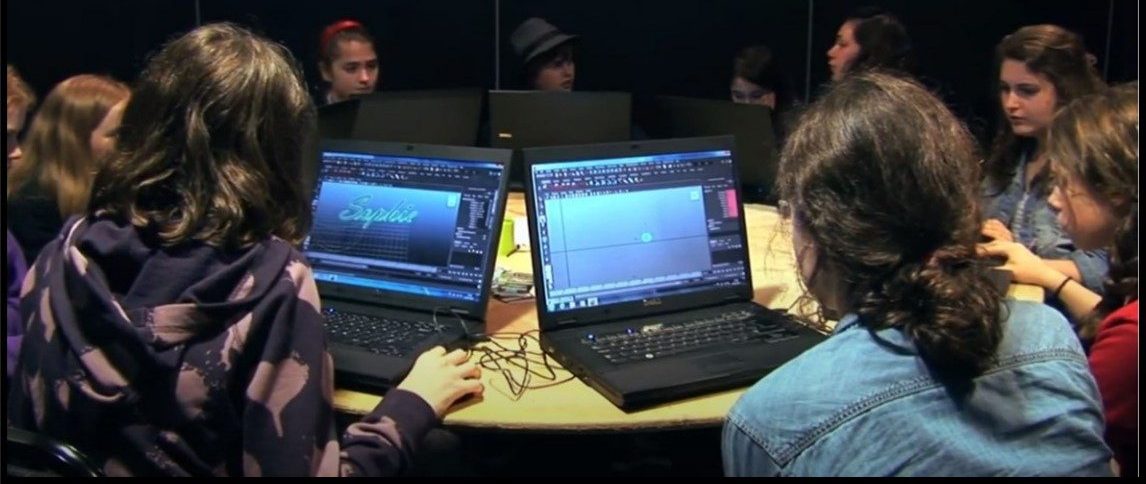
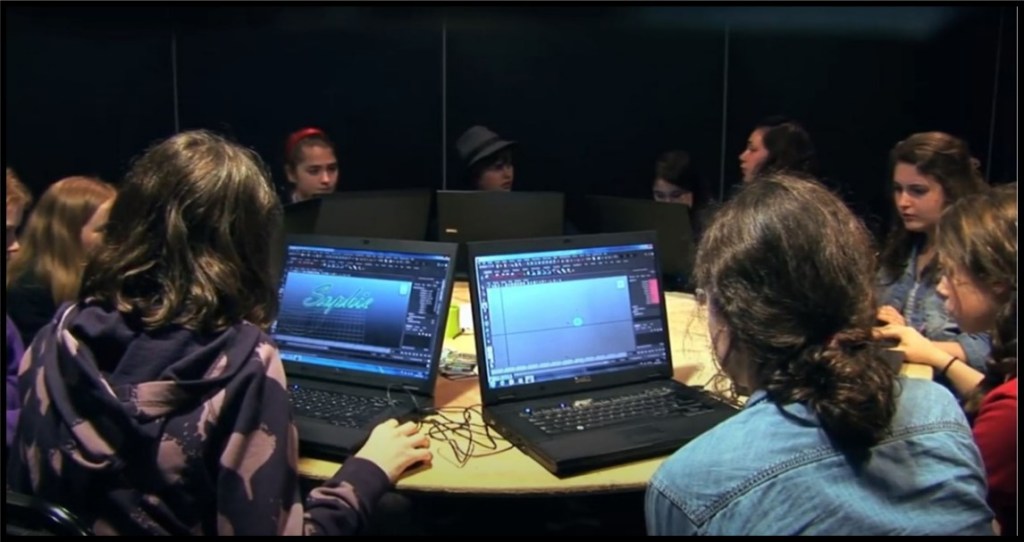
As a contrast, in the research for my PhD thesis I had some experience of the sort of situated learning advocated at Agora school in the Netherlands. In my role as an educational liaison and consultant for Games Britannia, a schools’ video-game festival I observed a number of workshops provided by game industry professionals, particularly on coding and game design development. One of these workshops used challenging mathematical concepts, usually associated with Advanced Level studies in Mathematics, during an exercise to teach 11-13-year-olds how to animate a bouncing ball. This sort of experience would have been an unlikely occurrence in a classroom, where introduction of concepts follows a linear, sequential and predictable pattern, but the inclusion of such a high level of challenge in a learning experience would usually be associated with risk of misunderstanding and disengagement.
Coding workshop: Games Britannia 2013
However, because the context of such learning was the development of game mechanics, this did not seem to be the case, as the facilitator/teacher and a participant in the session confirm in these quotes from a video interview :
We did a simple physics workshop where we did Newtonian mechanics… so they wouldn’t have known they were doing Newtonian mechanics …but that is what they were doing.
Lindsay Fallow (Stray), Games Britannia workshop, June 2013
We’ve been making a bouncing ball…it was really hard at first but then once you know how to do it, it’s easier.
Student in Lindsay Fallow’s workshop, Games Britannia, June 2013
The active participation of students in the learning process and the immediate feedback of the ‘bouncing ball’ appeared to produce high levels of engagement in this challenging learning experience. Yes, I hear you argue, but did the students understand what they had learnt and how it fitted into subject knowledge? Rob Houben (Agora) points out that the role of the teacher is to point out what the student has learnt – in this case, that the bouncing ball exercise was in fact Newtonian mechanics and part of Physics. The teacher’s role is to scaffold, contextualise and help students to make the connections
This brings us to the final two issues – the role of the teacher and the level of student agency and autonomy which might be desirable in the schooling experience. Simliarly to Biesta (2013) I am not arguing here for the replacement of teaching with learning, I argue that students should learn from teachers rather than be taught by them.
Bennett is rather scathing about the whole idea of student agency and autonomy
“Much of the Agora behaviour policy was based around the idea that we should trust children to direct their own behaviour… good luck with that. The myth of the ideal child is not, it seems, a myth for some.”
Bennett, 2021, Blog post
From my own doctoral research, a number of interesting ideas emerged about the effect that the student-teacher relationship has on the student experience and motivation. Formal schooling tends to produce hierarchical relationships between student and teacher and between formal and informal learning. This polarisation makes it difficult for students to make links between knowledge from out of school and knowledge acquired in school and for them to value their own knowledge in relation to that of the teacher.
In invisible pedagogy (Bernstein, 2014), as espoused at Agora, the school in the Radio 4 programme, students learn from teachers – although control is implicit, the teacher still makes the judgement about what needs to be learnt and when but can adjust and steer this to suit the student. This is what Peter Hyman, a contributor to the Radio 4 programme refers to when he mentions students being ‘apprentices’.
Visible pedagogy, espoused by Tom Bennett, has rules which readily translate into performance indicators and standardised schemes of work but can result in an over-emphasis on target-setting, written feedback and interventions. Where visible pedagogy predominates, agency stays largely with the teacher and participation by students takes the form of exam performance and the production of texts which satisfy assessment criteria. The focus in the classroom is on the behaviour of students and how to control that behaviour so that teachers are able to make the most efficient use of time and space and achieve the goal of good exam results. In order for this to occur power relations need to favour hierarchical relationships between teachers and students. Student participation becomes what Biesta (2015) calls pseudo participation when activity is set and controlled by others. Such relations tend to become demotivating for students.
My research findings suggest that it might improve student motivation and experience of learning if adult-child relations were sometimes less hierarchical, with regular opportunities for students to exhibit their own expertise, particularly around the use of ubiquitous technology such as mobile phones and tablets and to develop their own interests as the students at the Agora school do. In this way students could be encouraged to make links between their out-of-school and in-school knowledge and to evaluate alternative sources of knowledge such as Google and YouTube. As Hampson, Patton and Shanks (2013) point out, by taking students’ views into account schools can:
…help students to work in complementary ways alongside teachers, enabling them to play a more active part in shaping their own education and that of their peers (p.17)
Bennett concludes his review with this rather pessimistic statement about students and educationalists who don’t agree with him:
“Pretending that they (students) are some kind of innately altruistic beings who willingly self-direct their learning and behaviour towards the greater good is a fantasy that can only be sustained by people who have never worked with average children from the real world.”
Bennett, 2021
I can’t help feeling, both from this statement and from what he says in his book ‘Running the Room’, that Bennett’s cynicism is that of the reformed or re-constituted progressive and yes, the romantic. I’m calling for us to avoid that kind of dismissive comment and instead to keep the debate open. Let’s try to avoid reductionist views of education and educational practices. Let’s keep talking about, considering and exploring possibilities such as those raised by the Radio 4 programme. For example, should we be looking seriously at smaller schools? Should we be pursuing more personalised approaches to education rather than the one-size fits all ages and all children approach which often widens the inequality gap. How can we enable more personalised approaches? Perhaps through the sort of digital and blended experiences we all tried out during lockdown?
I look forward to lots of new thinking and debate!
A few years ago, as a Head of Department in a sixth form college, I took on the shared role of NQT (Newly Qualified Teacher) mentor for a new teacher, with a colleague from another academic department. Our approaches to mentoring were somewhat different. Whilst I interpreted the role as an opportunity to share what I knew about effective classroom practice and encourage the NQT teacher to question their own practice, my colleague saw it as a pastoral role in which they were responsible for checking on and ensuring the new teacher’s emotional and social well-being. We were probably a good team, in practice but the NQT teacher saw my approach, with a focus on classroom practice, as overly challenging and to quote ‘intimidating’. The particular practice which I challenged them about was their approach to feedback. Students in our shared classes were complaining to me that the teacher was setting lots of homework and assessed pieces but not returning for weeks afterwards or at all. I dealt with this by asking the teacher what they thought the purpose of homework and assignments was. They seemed somewhat surprised by this question and failed to come up with a satisfactory answer. I gently suggested that the purpose might be to improve and inform future work and help understanding. I further suggested that timing was crucial in the cyclical process of learning. If feedback is too distant from the particular assignment, homework or piece of learning, its effectiveness is reduced. If a student is to act on feedback it needs to be received in time to put into practice in the next assignment or piece of homework.
I watched the expression on the NQT teacher’s face as I told them this – it was like a lightbulb going on. They had clearly never considered feedback in that way. They had gone along with the procedures of the school and the traditional processes of teachers – teachers teach, they mark work and so on. I wish I could say that the teacher’s practice was changed radically – it did improve but they left teaching shortly afterwards.
Efficacy and feedback
I believe that the principle I was trying to establish with my NQT mentee is an important one – that feedback needs to be as close to and immediate to the learning activity as possible. This is where digital gaming has a lot to offer to the discussion. In digital games the emphasis is on the player experience. This experience is created in the relations between the affordances and constraints of the game and the player’s actions. Most digital games begin with a tutorial level.
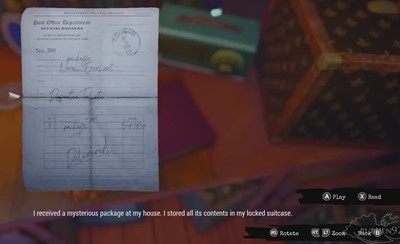
Screenshot by author – Call of the Sea X-Box game, Raw Fury, 2020
In this tutorial level the player is exposed to the typical experience of the full game but given many ‘just-in-time’ prompts (see screenshot from ‘Call of the Sea’ game above) about how to access information, how to navigate the environment and how to succeed. They can practise what they have learnt immediately, in a low-stakes but real game environment until the player feels confident they have mastered it. Then they can progress immediately into the full game experience – the pace is dictated by the player in a way that is not usually possible for a student in the classroom. The lack of ‘continuity’ in the learning network (student-teacher-assignment-environment) caused by the constraints of the school timetable can also lead to a lack of engagement and participation in the learning process. Whether you believe engagement is important to learning or not, any disconnect between acquiring knowledge and applying it must tend to reduce the likelihood of that knowledge being retained.
There has been a tendency in education policy in England to place undue emphasis on outcomes and assessment criteria. Mansell, James et al., (2009) suggest that the uses to which assessment is being putting is now too wide. Although low stakes assessment or formative assessment can be a valuable tool for promoting future learning, giving feedback to students and their parents about their learning and helping their understanding and achievement, schools are under increasing pressure to use formative assessment to predict future outcomes and lower the risk of a poor inspection or poor league table rankings (Page, 2017). Formative assessment has, therefore, also become heavily influenced by external assessment criteria. Student feedback is largely concerned with how these criteria can be met (Torrance, 2017).
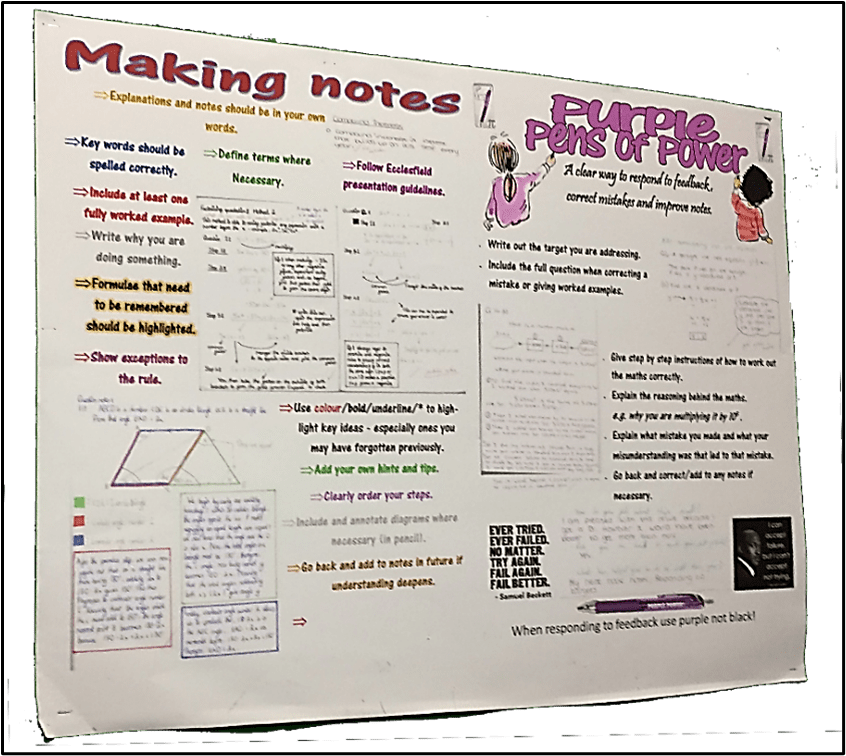
The emphasis on external assessment criteria has trickled down into the feedback and reflection practices prevalent in secondary schooling. Many secondary schools in England use a process called D.I.R.T or Dedicated Improvement and Reflection Time or Directed Improvement and Reflection Time. In D.I.R.T sessions, students receive their work (usually written) back from the teacher and are encouraged to reflect and write targets and make improvements to that piece of work. In principle, this sounds ideal – dedicated classroom time in which students are encouraged to reflect on work and improve it. In practice, this experience can be very different. It has become an over-regulated activity in which different coloured pens feature heavily, a formulaic and meaningless process, both for teachers and students.
Making Notes Poster, School E, Dunnett, 2021
One of the clear differences between D.I.R.T sessions and feedback in games is that D.I.R.T sessions are triggered by the return of a piece of assessed work rather than self-recognition of failure to achieve a goal or acquire a skill in a digital game.
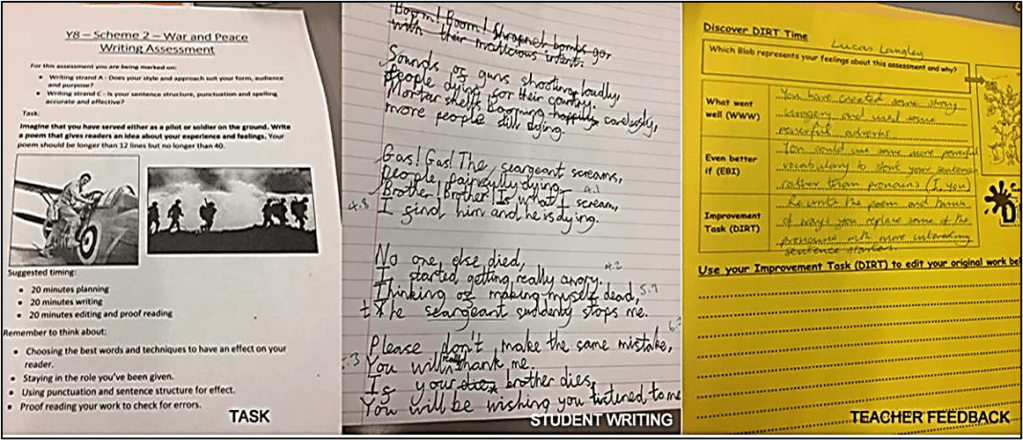
D.I.R.T documentation, School E, Dunnett, 2021
Student responses to teacher feedback in D.I.R.T sessions are required in a form that ‘readily translates into performance indicators…’ (Bernstein, 2004, p213) as is shown in the example above. Instead of students choosing to focus on self-identified misunderstandings or failings, the teacher uses a set of assessment criteria (see teacher feedback in the picture) to produce a list of weaknesses which the student is encouraged to address on a pro-forma. Teachers themselves identified D.I.R.T lessons as ‘hard work’ because of the constraints imposed by the assessment criteria and the formulaic nature of the activity.
“…students need to know where they are, how they’re learning… how they’re achieving, what they need to do to improve but do they actually need a form for them to write it down, for them to get a green pen out and to respond to something I’ve said that… do they actually need that?”
In contrast, I will describe a reflection process common to many digital games.
Screenshot by author, Clash of Clans game
Replay is an affordance offered by most digital games, which is widespread and accessible, giving players the opportunity to learn both from their own mistakes as well as the expertise of others. A ‘replay’ visually captures past actions performed by the gameplayer who can choose to watch the replay at a time of their choosing, can slow it down, stop it at certain sections and repeat them until they have worked out where they went wrong. They can also watch other game players play the same section of the game and learn from different approaches to the same task. I would emphasise the agency of the student here in identifying strengths in others gameplay (or work) as well as their own weaknesses. I would suggest that such experience increases the likelihood of a growth in self-efficacy. Rather than passively receiving written feedback based on assessment criteria, they are able to implement these new ‘strategies’ in their next game play session, in a multi-modal form.
I am not arguing that teacher feedback in school activities is not required – clearly it is a necessity, but I am arguing for an increase in opportunities for students to identify weaknesses outside of the assessment criteria – weaknesses they are motivated to improve. For example, in the lesson I observed on war poetry, which was discussed earlier, one student identified the need for more dramatic vocabulary and spent the lesson testing out his new vocabulary ideas on fellow students. Having established their effectiveness on a real audience, he took great joy in including them in his amended poem.
The way forward
Feedback and student reflection on learning seems to have taken on a high level of standardisation and repetition in many schools. Unlike games, where feedback is specific, visual and in-the-moment, reflection on learning in schools tends to consist of standardised and formulaic written responses, overly focussed on material elements such as pen colour and proformas and the de-contextualised reference to assessment criteria, with the potential to render the process meaningless.
More flexible and imaginative ways to reflect on learning are essential, such as the greater use of peer feedback, audio-recorded responses by teachers, model answers and online synchronous commenting on draft work, as well as the usual verbal feedback in lessons. Effective peer feedback relies on the creation of learning spaces where peer support and collaboration are normalised and valued which requires a greater tolerance for chatter and the acceptance that silence is not required in every lesson.
Feedback on work produced should not always be tied to assessment criteria either, but to the impact it creates. For example, in English there has always been a tradition of writing for real audiences on blogs and encouraging feedback from the wider public. International blogging initiatives such as Clusterblogging.net (see Twitter feed for @deputymitchell) both motivate and increase student achievement in writing. In Design Technology, artefacts can be created for use in school, with feedback from users, in the form of popularity and uptake in the use of a manufactured object.
The lack of external assessment, in the form of formal examinations and tests over the past year have given us the perfect opportunity to think again about our classroom practices and share new ideas about how to make the process more effective and motivating for both teachers and students.
“…I just find them (D.I.R.T lessons) hard work… its hard work to engage students on a feedback style …cos it’s so black or white with what we’re feeding back on… you put, it was wrong, this is what you should have put. I don’t think they learn anything by writing it down in green pen.”
Bernstein, B., 2004. The structuring of pedagogic discourse. Routledge.
Mansell, W., James, M. & Group, A. R., 2009. Assessment in schools. Fit for purpose? A Commentary by the Teaching and Learning Research Programme. In: Economic And Social Research Council, T. & Programme., A. L. R. (eds.). London.
Page, D., 2017. The surveillance of teachers and the simulation of teaching. Journal of Education Policy, 32, 1-13.
Torrance, H., 2017. Blaming the victim: assessment, examinations, and the responsibilisation of students and teachers in neo-liberal governance. Discourse: Studies in the Cultural Politics of Education, 38, 83-96.
In the past few months, some teachers and educational commentators in newspapers and on social media such as Twitter, have called for a re-assessment of the way that children learn, after arguably the biggest upheaval to traditional schooling since the two World Wars in the early 20th century. The calls for a radical re-think of educational practices have ranged from suggesting a complete overall of the curriculum and the assessment regime, to changing the way we ‘measure’ engagement. One thing is for sure, these enforced periods of online learning have changed teaching and learning practices, whether we think this has been for better or for worse. In this post I argue that we should take this opportunity to embrace new ways of understanding educational practice, retaining what has been learnt during this period and re-evaluating some of our former pedagogical practices
Over the course of the three COVID 19 lockdowns, in my role as a digital education consultant, I have supported a small multi-academy trust in the Midlands, which comprises twelve primary schools and two secondary schools. My expertise in digital education has been built over the course of a 23-year career as an English teacher and curriculum leader in secondary and tertiary education and 5 years of working as an educational technology consultant in a large group of secondary schools in South Yorkshire. To support this practical experience, I recently completed a doctoral thesis which explored the links between boredom and disengagement from learning and teaching and learning practices in schools, Throughout my career, however, my primary interest and motivation has been the everyday teaching practices of classroom teachers and their relationship to educational technology.
The Trust I have been supporting has 12 primary schools who have embraced online learning with varying degrees of enthusiasm. Even in the first lockdown in 2020, some teachers immediately grasped the new possibilities of the remote, online environment. Schools that avoided the direct transferral of in-person teaching and learning practices online i.e. timetabled days of ‘live’ lessons, have been able to take advantage of a wider range of temporal and spatiality possibilities.
Rather than attempting to reproduce ‘school’ online, replicating the timetable, rules and routines of their physical school, some teachers gave their students a ‘menu’ of learning each day. This menu approach recognised that time, space and access to devices such as laptops varied hugely. Is it really necessary for all students to learn the same thing, at the same time and the same pace, if we have dispensed with the physical classroom and the traditional school day?
For many years schools have been organised on the assumption that all students should be learning the same thing, at the same time and roughly the same pace, within one classroom1. Online learning has turned this on its head – for some teachers and students at least. Yes, there have been schools who have simply replaced like for like – whole days of ‘live’ lessons, as close to an exact replica of the physical classroom as possible. I believe these schools have missed a trick. Schools which have taken a more varied approach have reaped the dividends. By recording lessons, rather than making them all live, for example, you give students the ability to stop, start and replay your teacher input. The lesson can remain on your online platform for review. Students’ ability to manipulate lesson content has been associated with increased engagement with that content2. In many schools, content has been uploaded for students to access at their leisure and to edit at will to suit their own purposes. In my own MAT for example, OneNote Class Notebook has been used to distribute copies of worksheets and information, where it is stored in their own personal ‘exercise book’ and where students and teachers can access, edit and comment on it. Gone are the days of ‘the dog ate my homework’ or ‘I didn’t get the worksheet Miss’. Admittedly in some cases that has been replaced with ‘I can’t access the files from my phone’ or ‘My Wi-Fi doesn’t work’!
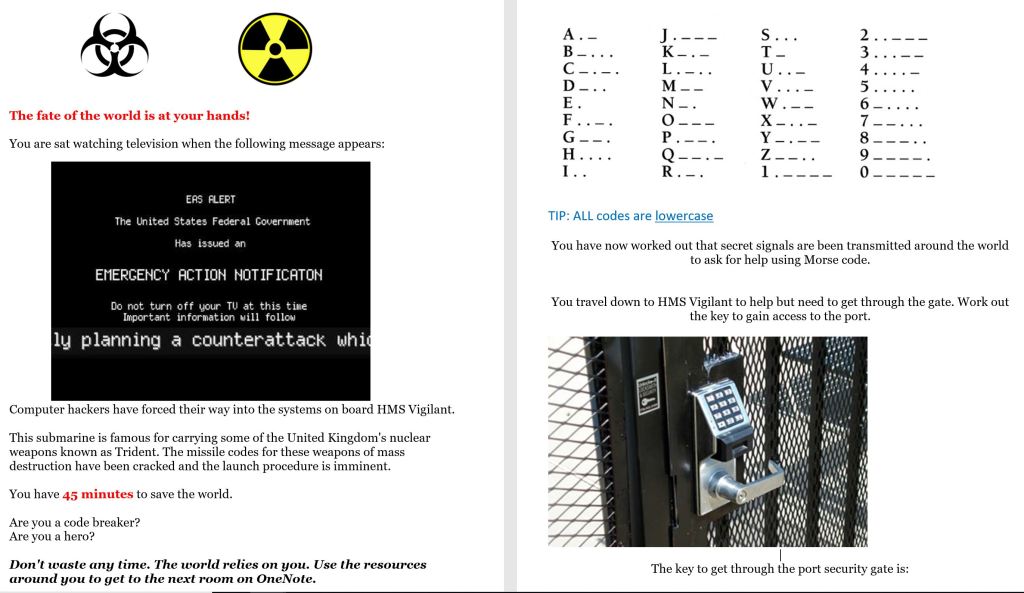
OneNote Class Notebook – Computing Learning activity
Online learning has changed the traditional dynamic of highly regulated physical space. Instead, education spaces such as classrooms are constructed through relations between social and material actors – students, teachers, technology, objects and environment. As Burnett (2013)3 describes, the concept of classroomness – a ‘mesh of practices’ is created in the online space, where official and unofficial spaces exist simultaneously – breakout spaces, chat, the home environment, the school classroom, YouTube and Oak National Academy and so on.
In such spaces, there is no need to construct elaborate seating plans to separate Johnny from best mate Matt, to stop Milly throwing her pen at Faizah or engineer ability groups to work together. Everyone is ‘facing the front’ in Google Classroom and Microsoft Teams, with students in a neat grid on the screen but in reality, can physically be in any position they choose from lounging on the bed, to sitting at the dining room table. Noise, another bug bear of physical classroom teaching has become a thing of the past. Teachers can mute any student speaking out of turn or all students during teacher presentation. All students can ‘see the board’, in the online PowerPoint presentation – assuming they have a device and managed to get online at all!
Concentration and the ability to pay attention have long been considered to be measures of behavioural compliance and essential for learning. School rules are inherently spatial – they control bodies, movement, talk, noise, learning, space and time and tend towards uniformity and standardisation. Much of this regulation is aimed at controlling children’s behaviour rather than directly affecting learning or pedagogy. So, does regulating time and space result in higher concentration and improved learning? There is good evidence that distraction, whether that be through visual stimulation or other sources, can affect concentration and learning. One might expect distraction to be a bigger problem in the home environment than in a school classroom. However, that has not necessarily been the case. Because students have been able to engage with the teacher and the lesson material at different times, of their own choosing, to access multi-modal information, it has been possible for students to engage with material in different ways and for differing lengths of time, reducing the likelihood of inattention.
What has emerged from my observation of both in-person, physical classrooms and online learning spaces is that the organisation and regulation of time and space has a big effect on the affective experience of students. High stakes assessment and the need for predictable outcomes have dictated the use of timetables and seating plans to regulate the relations between student, teacher, resources and space. Online learning has increased the mobility of these elements and different affective dynamics have been created.
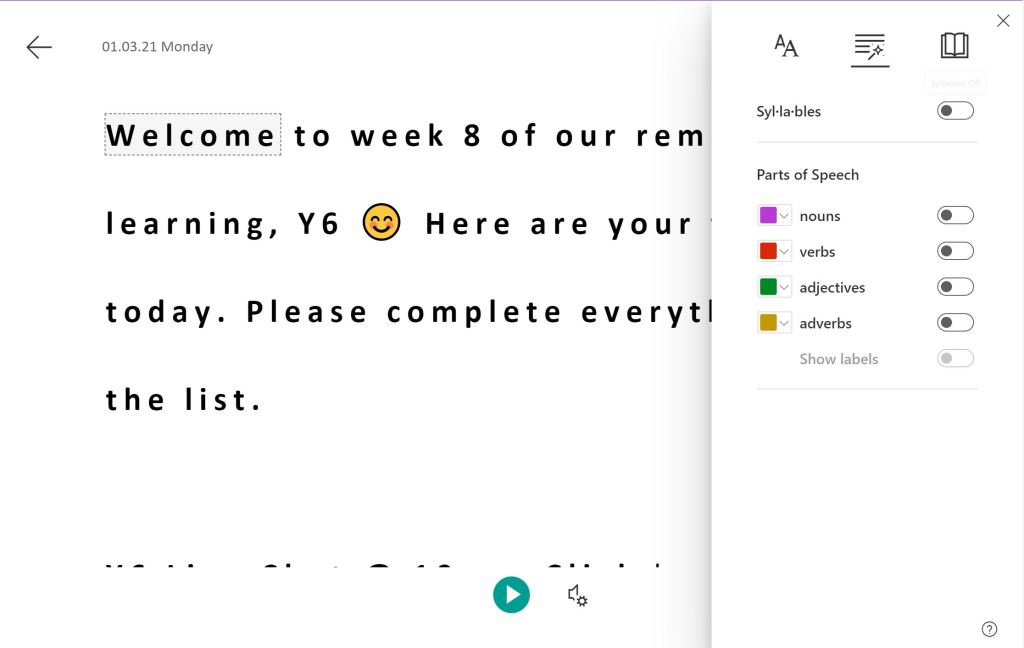
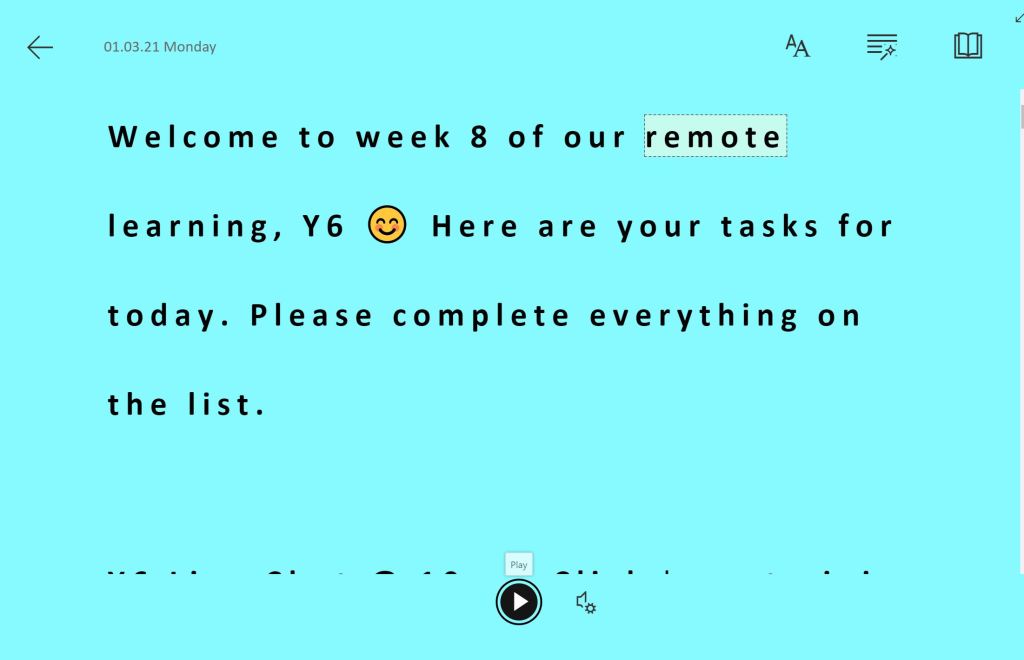
So, what are the takeaways from online learning? In many cases student agency has been increased as they have been expected to take a role in managing their access to resources, whether that be the pace at which they consume content or the way they personalise it so that it makes sense to them. An example of this is the use of the accessibility tools such as Immersive Reader in OneNote Class Notebook where students can apply a filter to a text, get the text read aloud or broken down into manageable chunks at the touch of a button, something not possible without considerable graft from their teacher in the physical classroom.
OneNote Class Notebook – Immersive Reader
By being able to choose how to use of their own time, necessarily repetitive activities such as practising examples in Maths can be spread out over the whole day. The ability to choose how to use their own physical space has meant that reading can be done in a comfortable chair or lying on a bed. Ask yourself when was the last time that you read for pleasure, sitting at a desk?! Reading can also go on as long as the student wants rather than being artificially cut short, as we often have to do, to make reading fit within the school timetable.
Activities which we might have liked to do in the classroom but which just take up too much time and disrupt the school day, such as collecting samples of grass, worms, or household materials can now become part of an online learning experience, with students taking pictures or filming themselves and feeding back in a ‘live’ video call.
Participation in online lessons has not been restricted to handwritten texts – students have submitted video footage of them performing tasks, teachers have included home learning such as baking a cake, in their ‘lesson’. We can assess understanding of a process such as collecting samples or executing a football skill by watching rather than reading a report of the activity.
My own research findings suggest that when adult-child relations are less hierarchical, as they have often been online, there can be regular opportunities for students to exhibit their own expertise, particularly around the use of ubiquitous technology such as mobile phones and tablets and to develop their own interests and expertise. Students have been encouraged by their teachers to make links between their out-of-school and in-school knowledge and to evaluate alternative sources of knowledge such as Google and YouTube.
Of course, returning to face-to-face learning and the physical classroom will be an enormous relief to both teachers and students. For most students, nothing can replace the social and educational experience of the physical classroom. For others, I have heard many examples of quiet, withdrawn students blooming in the online environment, even taking the lead in online discussion and activities. I have my own personal teaching experiences of this phenomenon too. More time to think and respond, less likelihood of another student talking over you or answering more quickly perhaps?
My own doctoral research has suggested that incorporating a more social and material approach to understanding educational practices might be helpful, particularly after the past year of COVID 19 restrictions. Such an approach encourages us to see schools as networks rather than bounded, stable places or ‘static containers’. Teachers might want to incorporate what has been learnt from online learning practices, to look beyond the usual distinctions between formal/informal learning and in and out of school practices in order to re-evaluate the whole experience of learning in the classroom,
References:
Bielaczyc, K. and Collins, A., 1999 Learning communities in classrooms: A reconceptualization of educational practice. Instructional-design theories and models: A new paradigm of instructional theory, 2, pp. 269-292..
Jewitt, C., Moss, G. and Cardini, A., 2007. Pace, interactivity and multimodality in teachers’ design of texts for interactive whiteboards in the secondary school classroom. Learning, Media and Technology, 32(3), pp.303-317.
Burnett, C., 2014. Investigating pupils’ interactions around digital texts: A spatial perspective on the “classroom-ness” of digital literacy practices in schools. Educational Review, 66(2), pp.192-209.

 Learning in the Digital Age